Everyone can collect compliance evidence. But can you tell what it means?
Episode 02 of the Vero AI Perspective series. Every compliance stack has three layers most teams already own — collection, gap analysis, and the audit conclusion. This paper is about the layer quietly missing between them: evidence evaluation. It is the judgment work of deciding whether a specific artifact actually satisfies the requirement it is mapped to, and producing a defensible, traceable record of why. The paper defines the layer, sets the four bars real evidence evaluation must meet, and shows why the work naturally splits into two jobs — readiness (GRC) and testing (SOX) — running on one evaluation engine.
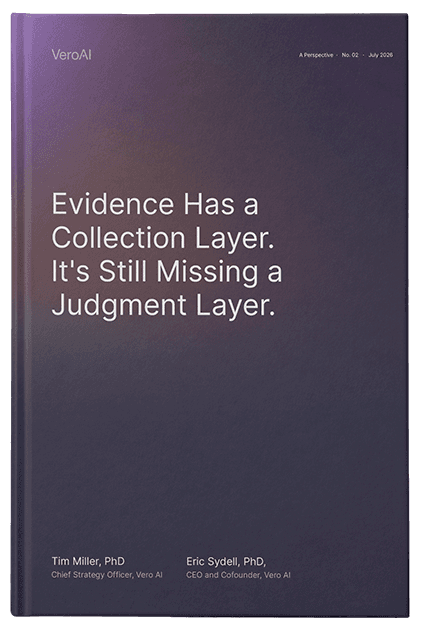
Why We Wrote This Perspective on Evidence Evaluation
To Name the Layer the Compliance Stack Quietly Skips
Every organization we talk to has tooling for collection and gap analysis, and every organization eventually produces an audit conclusion. But between 'we have something filed here' and 'this evidence meets the standard and here is the defensible record of why' is a layer the stack does not name — the layer where a person with a spreadsheet is quietly doing the work. We wrote this paper to name it, because layers that do not have names do not get invested in.
To Replace 'We Have the Evidence' With 'The Evidence Means Something'
Collecting artifacts is a solved problem. Judging whether an artifact actually satisfies the requirement it is mapped to — and doing it consistently, at scale, with a record an auditor can rely on — is not. We wrote this paper to move the conversation from evidence volume to evidence meaning, because that is where the audit actually lives.
To Show Why Readiness And Testing Are Two Different Workflows On One Engine
Readiness work (does our documentation align to the framework?) and testing work (did this control actually operate, and can we prove it?) are genuinely different jobs — different inputs, different setup, different outputs, different questions answered. We wrote this paper to explain why Vero AI runs both as two workflows on one evaluation engine, and why treating them as the same workflow is where evidence evaluation usually breaks down.
Why You'll Want to Read This
To Draw the Compliance Stack Honestly for Your Own Team
The paper lays out the stack as four layers — collection, gap analysis, evidence evaluation, audit conclusion — and shows exactly where today's tooling stops and where the manual review begins. It is a diagram you can put in front of a leadership team without arguing about vendor categories.
To Choose Readiness Tooling and Testing Tooling With Eyes Open
The paper's side-by-side matrix compares readiness (GRC) and testing (SOX) across primary focus, input material, setup, output, and use cases. Use it to decide which parts of your program need low-prep breadth and which parts need deep, specialized artifact testing — and to stop expecting one tool to do both.
To See Where Evidence Evaluation Leads Next
The paper closes on the horizon Vero AI is building toward: Cognitive Compliance for Audits. Not a faster way to check evidence one artifact at a time, but a standing intelligence that reasons across the whole body of evidence — connecting a single control to the frameworks it touches, surfacing contradictions, and carrying judgment forward so each audit begins smarter than the last.
Questions Compliance Leaders Ask About Evidence Evaluation
Ready to see evidence evaluation on your own data?
Map your gaps with Vero AI for GRC. Prove your controls with Vero AI for SOX. One evaluation engine, purpose-built for each job.
Request a demo