How Should Audit Leaders Build a Credible AI Program in 2026?
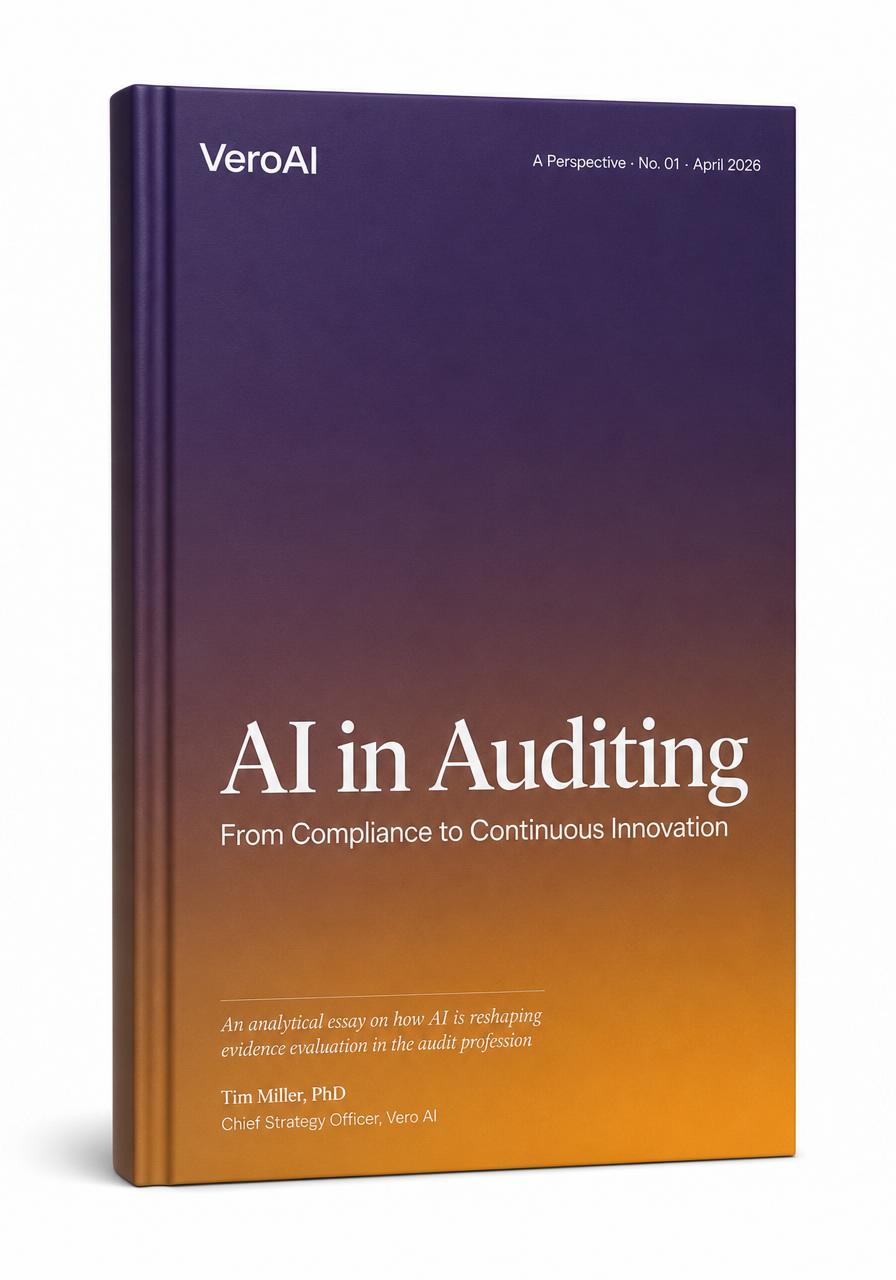
This perspective paper gives audit leaders an honest read on where AI is actually useful inside an engagement, where it is not, and what a credible program looks like in 2026. It defines what AI really is inside an audit — statistics applied to unstructured data — and traces the shift from sample-based testing to full-population review, from periodic checks to continuous compliance. Drawing on AICPA, PCAOB, IAASB, NIST, ISO, and EU AI Act sources, it lays out four profession-specific risks, the four skills audit teams need now, a five-level maturity model, and a twelve-item readiness checklist designed to be completed in one sitting and taken into the next audit committee meeting.
Why We Wrote This Perspective on Auditing with AI
To Replace AI Hype With a Working Document for the Profession
The audit profession has lived through every hype cycle since expert systems in the 1990s, and very little of it changed the daily life of an auditor. We wrote this paper as a working document — refreshed annually — that gives audit leaders an honest read on where AI is actually useful inside an engagement, where it is not, and what a credible 2026 program looks like.
To Reframe the Real Shift — From Sample to Population
The breakthrough is not that machines can imitate human language. It is that the unstructured record of a company — contracts, invoices, emails, control narratives, policy libraries — can now be read at a scale a human team could never match. We wrote this paper to argue that the conversation with the audit committee should change from 'how large a sample gives us comfort' to 'what should we be looking at that we were never able to look at before.'
To Put Profession-Specific Risks on the Table
A serious paper on AI in audit has to address where deployments actually break down inside a firm — not the generic risks of AI, but the four risks specific to the profession: independence and vendor conflicts, client data under the AICPA Code of Professional Conduct, erosion of professional skepticism, and the velocity of standards bodies (IAASB, AICPA ASB, PCAOB). We wrote this paper to make those risks concrete and give audit leaders a framework for managing them in front of an audit committee.
Why You'll Want to Read This
To Locate Your Practice Honestly on a Maturity Curve
The paper introduces the Vero AI Audit Maturity Model — a five-level self-diagnostic designed to be used in front of an audit committee, not as a scorecard for self-congratulation. It is built to help audit leaders set an honest twelve-month target rather than a five-year roadmap.
To Understand Where Judgment Is Still the Product
Many AI programs disappoint because leaders assume the technology replaces senior staff. This paper shows why mature deployments do the opposite. The same number of seniors do a different job — reviewing the queue the machine produces, making the judgment calls the machine cannot, and spending freed capacity on strategic questions the old engagement never had room for. Machines for scale. People for meaning.
To Walk Out With a Twelve-Item Readiness Checklist
The paper closes with a one-page diagnostic across data readiness, governance, team skills, and tooling. It is designed to be completed in one sitting, shared with an audit committee, and used as the baseline for the same exercise twelve months from now. It is the smallest useful first step a firm can take toward a credible program.
Questions Auditors May Have About Using AI in Their Profession
Ready to experience the future of audit?
See how Vero AI encodes professional judgment to deliver consistent, defensible findings — at enterprise scale.
Request a demo