Article
5 Essential Risk Management Framework Examples

Eric Sydell, PhD
|
Updated on
|
Created on
Discussing risk in terms of "high," "medium," or "low" often fails to provide the clarity needed for effective decision-making. To secure budgets and align security with business objectives, leaders must articulate risk in a language the entire organization understands. A formal risk management framework helps translate these abstract concerns into a structured, measurable process. Some frameworks even allow you to quantify risk in clear financial terms. By examining different risk management framework examples, such as the quantitative FAIR model and the controls-focused COSO framework, you can build a program that provides objective data for prioritizing threats and justifying security investments.
Key Takeaways
Move from reactive to proactive management: A formal framework provides a repeatable process for identifying and addressing business risks before they become significant problems.
Select a framework that fits your context: Evaluate options like NIST for security, COSO for financial controls, or ISO 31000 for general principles to find the best match for your industry and goals.
Integrate risk management into your culture: A framework is most effective when it is embedded in daily operations and regularly reviewed, making risk awareness a shared responsibility across the organization.
What Is a Risk Management Framework?
A Risk Management Framework (RMF) is a structured process that helps an organization identify, assess, and respond to risks. It provides a consistent set of guidelines and best practices for making decisions about uncertainty. The goal is to protect company assets and support business objectives.
By using a framework, organizations can create a repeatable method for handling threats. This includes everything from cyberattacks and operational failures to new regulatory requirements. A structured plan helps leaders understand the potential impact of each risk and decide how to address it.
Most frameworks guide teams through a continuous cycle. This process typically starts with identifying potential risks across the organization. Next, teams analyze the likelihood and impact of each risk to prioritize them.
Based on this analysis, the organization develops strategies to mitigate, transfer, accept, or avoid the risks. The final step involves implementing these strategies and continuously monitoring the results to adapt to new threats. Using a Risk Management Framework helps ensure this process is applied consistently across all departments.
Why Your Organization Needs a Risk Framework
A risk management framework is a structured plan that helps your organization identify, understand, and reduce risks. It provides a consistent method for making smart decisions, protecting company assets, and reaching business goals. Without a formal framework, teams are often left reacting to problems as they appear rather than preparing for them in advance.
This proactive approach is crucial for long-term success. A clear framework helps a company protect its reputation, avoid financial losses, and maintain smooth operations, even when faced with uncertainty. It transforms risk management from a series of urgent responses into a predictable and strategic business function.
Managing risk is not just about current problems; it’s about preparing for new ones. Cybersecurity vulnerabilities, for instance, are now a major business issue that can impact the entire organization, not just the IT department. A framework helps you stay ahead of these emerging threats.
By evaluating performance metrics, you can gain a clear understanding of your organization’s level of risk exposure. This data shows whether vulnerabilities are being managed effectively. Over time, this process strengthens your organization’s security and compliance posture, building trust with auditors, regulators, and customers.
The NIST Risk Management Framework (RMF)
The National Institute of Standards and Technology (NIST) developed the Risk Management Framework (RMF) as a guide for organizations. It provides a structured, seven-step process for managing information security and privacy risks.
This framework helps organizations select and implement security controls. It also provides a way to monitor the effectiveness of those controls over time. The goal is to integrate risk management into every stage of a system's life cycle, from development to decommissioning.
While originally created for U.S. federal agencies, the NIST Risk Management Framework is now widely adopted by private sector companies. Many use it to protect their information systems and data. The framework’s detailed guidance makes it a valuable resource for any organization looking to build a mature cybersecurity program.
How the NIST RMF Works
The NIST RMF follows a clear, repeatable process. Each step builds on the one before it, creating a comprehensive approach to managing security. The framework helps teams make informed decisions about how to protect their systems.
The process includes seven main steps: prepare, categorize, select, implement, assess, authorize, and monitor. It starts with preparing the organization to manage risk and then moves to categorizing systems based on their importance. From there, teams select, implement, and assess controls. The final steps involve authorizing the system to operate and then continuously monitoring for risks.
When to Use the NIST RMF
The NIST RMF is mandatory for U.S. federal government agencies. It is also required for contractors who work with these agencies. This ensures a consistent security standard for all federal information systems.
Beyond government requirements, many private companies choose to adopt the framework. It is especially useful for organizations in critical infrastructure sectors like finance, energy, and healthcare. Any business that needs a thorough and defensible approach to cybersecurity can benefit from the RMF. Its structured process helps demonstrate due diligence and align security efforts with established best practices.
The ISO 31000 Risk Management Standard
ISO 31000 is an international standard that provides principles and general guidelines for risk management. Unlike many other ISO standards, it is not used for certification. Instead, it offers a framework that can be adapted to any organization, regardless of its size, industry, or sector. The main goal of ISO 31000 is to integrate risk management into an organization's governance, strategy, planning, and daily operations. This approach helps embed risk-based thinking into the company culture, making it a shared responsibility rather than a siloed function.
The standard views risk management as a continuous process that creates and protects value. It helps organizations improve performance, support innovation, and achieve their objectives. By following its principles, companies can develop a risk management approach that is specific to their needs and context. This makes risk a key consideration in every decision, from high-level strategy to routine tasks. The framework is designed to be comprehensive yet flexible, covering everything from establishing the risk context to monitoring and review. It provides a universal language for risk, which helps improve communication among stakeholders and supports consistent risk management practices across different parts of the business.
Understanding Its Principles and Structure
The ISO 31000 framework is built on the idea that effective risk management must be integrated, structured, and comprehensive. It recommends that leadership commits to managing risk with a clear statement and provides the necessary resources. This includes assigning clear roles and responsibilities to individuals across the organization. The framework is one of several essential risk management frameworks that formalize a company's approach to uncertainty.
At its core, the standard promotes making risk management a central part of the company’s structure, processes, and goals. It involves everyone, from top executives to front-line staff, in identifying and managing risks. This approach ensures that risk-based thinking becomes a natural part of the organizational culture.
Common Industry Applications
Because ISO 31000 is a set of guidelines rather than a strict set of rules, it is highly adaptable. This flexibility makes it suitable for a wide range of industries, including healthcare, finance, technology, and manufacturing. Any organization can use its principles to integrate risk management into its operations. For example, a financial institution might use it to manage market and credit risks, while a healthcare provider could apply it to patient safety and regulatory compliance.
By using ISO 31000, organizations can improve their ability to handle new and changing threats. It helps them build resilience and strengthen their compliance posture. Its universal nature makes it one of the top risk management frameworks for companies that need a foundational model for managing uncertainty.
The COSO Enterprise Risk Management Framework
The Committee of Sponsoring Organizations of the Treadway Commission (COSO) offers a widely used framework for internal controls. The COSO Enterprise Risk Management (ERM) Framework helps organizations manage risk across the entire business. It provides a structure for connecting risk management activities directly to an organization's strategy and performance goals.
Originally focused on financial reporting controls, the framework has evolved significantly. The updated 2017 version places a greater emphasis on the link between risk, strategy, and value creation. It helps leaders consider how risk affects their ability to achieve business objectives. This makes it particularly useful for public companies concerned with Sarbanes-Oxley (SOX) compliance and for organizations looking to build a more resilient business model.
The framework is built around five interrelated components. These components guide organizations in establishing governance, setting objectives, identifying and assessing risks, and monitoring performance. By applying the COSO Enterprise Risk Management Framework, companies can create a more consistent and comprehensive approach to managing uncertainty. This helps leadership make better-informed decisions and provides greater confidence to stakeholders, including boards and regulators. The structure is flexible enough to apply to different industries and organizational sizes.
How to Integrate Risk with Strategy
The COSO framework helps companies see risk management not as a separate compliance function, but as a part of setting and achieving strategic goals. It provides a clear path for integrating risk discussions into performance management. The framework’s five components guide this process: Governance and Culture; Strategy and Objective-Setting; Performance; Review and Revision; and Information, Communication, and Reporting.
This structure encourages organizations to identify risks that could affect their strategic objectives. The 2017 update specifically helps businesses handle challenges from new technologies and large volumes of data. By using these essential risk management frameworks, leaders can better align their risk appetite with their overall strategy and improve decision-making across the enterprise.
Focusing on Financial and Operational Risk
A key part of the COSO framework is using performance data to understand risk exposure. By evaluating specific metrics, you can see if vulnerabilities are being managed effectively. This requires developing and monitoring Key Performance Indicators (KPIs) and Key Risk Indicators (KRIs). These metrics provide objective data that helps organizations track their risk levels and make informed decisions.
For example, a KRI might track the number of failed internal control tests, while a KPI measures operational efficiency. Together, these risk metrics create a clear picture of an organization's health. This is critical for financial reporting integrity and SOX compliance, where auditors and regulators expect to see evidence that risks are being actively monitored and managed.
The FAIR Model (Factor Analysis of Information Risk)
The Factor Analysis of Information Risk (FAIR) model offers a different way to look at risk. Instead of using qualitative labels like "high," "medium," or "low," FAIR focuses on numbers. It is a framework for understanding, analyzing, and quantifying information risk in financial terms. This helps leaders see risk not just as a technical problem, but as a business problem with a clear financial impact. It provides a structured approach to measure the components of risk, like threat event frequency and probable loss magnitude, and how they relate to each other.
The model provides a standard taxonomy and analysis method for information risk. This allows organizations to build a consistent and defensible risk management program. By translating abstract cyber threats into potential dollar losses, you can have more productive conversations with executives and board members. It helps answer specific questions like, "How much risk do we have?" and "What is the return on our security investments?" This quantitative clarity is essential for making informed, data-driven decisions about security spending and strategy. It moves the conversation from fear and uncertainty to a clear business case, which is critical for securing budgets and aligning security with business objectives. The Factor Analysis of Information Risk model helps teams articulate risk in a language the entire business can understand.
Taking a Quantitative Approach to Risk
The FAIR model is an international standard that helps organizations measure cyber and operational risks in financial terms. This quantitative approach moves beyond simply identifying gaps. It allows you to understand the potential financial impact of risks and the probability of them happening. This is a major shift from traditional, more subjective assessments.
With this financial data, you can prioritize which risks to address first based on their potential cost to the business. This enables companies to better understand the financial implications of risks. This clarity helps you allocate resources more effectively. You can make a stronger business case for security initiatives by showing their direct impact on reducing financial exposure.
Applying FAIR to Information Security
Putting the Factor Analysis of Information Risk (FAIR) model into practice involves a few key steps. A central part of this process is developing Key Risk Indicators (KRIs). These are metrics used to analyze risk levels across different business operations. They help you monitor changes in your risk environment over time.
Defining tolerances and aggregating data helps turn KRIs from abstract ideas into concrete metrics. These metrics can then be integrated into your ongoing risk monitoring processes. This application of FAIR makes your risk assessments more precise. It also strengthens your organization's overall security posture by grounding it in measurable data.
The OCTAVE Risk Assessment Methodology
The Operationally Critical Threat, Asset, and Vulnerability Evaluation (OCTAVE) framework offers a different way to look at risk. Developed by the Software Engineering Institute at Carnegie Mellon University, it is a self-directed methodology. This means it empowers an organization’s own people to identify and assess information security risks.
Unlike some top-down frameworks, OCTAVE is built on the idea that the people closest to the assets and processes know them best. It brings together a small, interdisciplinary team of employees from business units and IT. This team learns to conduct the risk assessment themselves, building a repeatable capability inside the organization. The framework comes in a few variations, including the original OCTAVE Method, OCTAVE-S for smaller organizations, and OCTAVE Allegro, a more streamlined approach. The core principle remains the same: use internal knowledge to build a security strategy that fits your specific business context.
A Self-Directed Approach to Risk Evaluation
The self-directed nature of OCTAVE is its key feature. Instead of relying entirely on external consultants, the framework guides an internal team through the evaluation process. This team learns to identify critical assets, analyze threats, and understand vulnerabilities without needing deep security expertise at the start. The process itself builds awareness and a sense of ownership over security outcomes.
By training internal staff, organizations create a sustainable risk management practice. The team can repeat the assessment as business conditions change. This approach fosters a culture of security responsibility, where protecting information becomes an integrated part of everyone's role. The goal is not just to produce a risk report but to build lasting risk management capabilities within the company.
Focusing on Organizational Security
OCTAVE directs teams to focus on assets that are truly critical to the organization's mission. The process begins by identifying these key assets and understanding what makes them important. From there, the team evaluates the security threats relevant to those specific assets, both from internal and external sources. This asset-centric view ensures that security efforts are practical and tied to real business impact.
The framework helps organizations prioritize their security investments effectively. By connecting vulnerabilities directly to critical assets and threats, the team can see which weaknesses pose the greatest danger. This allows leaders to allocate resources where they will have the most meaningful effect. The result is a security strategy that aligns with and supports the organization's primary business objectives.
Which Industries Benefit Most from These Frameworks?
Risk management frameworks are designed to be adaptable, but they are especially vital in highly regulated industries where compliance is not optional. Sectors like finance, healthcare, government, and technology rely on these structured approaches to manage complex risks and meet strict legal requirements. The right framework helps an organization protect sensitive data, ensure operational stability, and maintain public trust.
Choosing a framework often comes down to the specific challenges an industry faces. A financial institution might prioritize frameworks that address financial reporting integrity, while a government agency will focus on those that secure national data. Each framework offers a different lens through which to view and manage risk, allowing organizations to select the one that best aligns with their operational realities and regulatory obligations. This alignment is key to building a resilient and compliant organization.
Use Cases in Healthcare and Financial Services
In healthcare, protecting patient data is a primary concern. Frameworks like ISO 31000 and the NIST RMF provide the structure needed to comply with regulations such as the Health Insurance Portability and Accountability Act (HIPAA). These frameworks guide organizations in managing risks tied to patient data security, operational processes, and regulatory adherence.
The financial services industry uses frameworks to align risk management with strategic goals. The COSO ERM framework is a popular choice for its focus on financial reporting and operational controls, which helps organizations meet Sarbanes-Oxley Act (SOX) requirements. By using COSO, financial firms can better identify and mitigate risks that could impact their stability and reputation.
Requirements for Government and Tech
Government agencies operate under strict mandates to protect sensitive information. The NIST Risk Management Framework (RMF) is often a requirement, offering a detailed process for managing information security risks across federal systems. This framework is essential for safeguarding national data and ensuring that agencies follow federal security standards.
The technology sector faces unique challenges, particularly in quantifying digital threats. Frameworks like Factor Analysis of Information Risk (FAIR) help tech companies translate cybersecurity risks into financial terms. This quantitative approach allows leaders to prioritize security investments based on potential financial impact, making risk management a core part of business strategy.
What Are the Common Implementation Challenges?
Adopting a risk management framework is a significant step for any organization. Even with the right model selected, teams often face hurdles during implementation. These challenges typically involve managing resources effectively and guiding the organization through change.
Managing Limited Resources and Evolving Risks
Many compliance and audit teams operate with limited budgets and staff. This makes it difficult to implement a new framework while keeping up with daily responsibilities. At the same time, enterprise risks are changing faster than ever before.
According to analysis from Baker Tilly, the most effective enterprise risk management (ERM) frameworks use metrics to monitor these evolving threats. Teams can use Key Risk Indicators (KRIs) and Key Performance Indicators (KPIs) to track risks proactively. If your organization already uses a risk management system, you can use existing data from control assessments to analyze your KRIs, as noted by Metricstream. This approach helps you make the most of the resources you already have.
Handling Change Management and Identifying Risks
A framework is more than a document; it requires changes to how people work and make decisions. The process involves several phases, from developing KRIs to defining risk tolerances and integrating them into daily monitoring. This requires a clear change management plan to ensure everyone understands their role.
To protect an organization from operational and reputational harm, teams must conduct regular reviews of their KRIs. This practice also helps with reporting key risks to leadership in a timely manner. By consistently evaluating performance metrics, you can better understand your organization’s risk exposure. This evaluation shows whether vulnerabilities are being managed, which strengthens the company’s overall security posture.
How to Choose the Right Framework for Your Organization
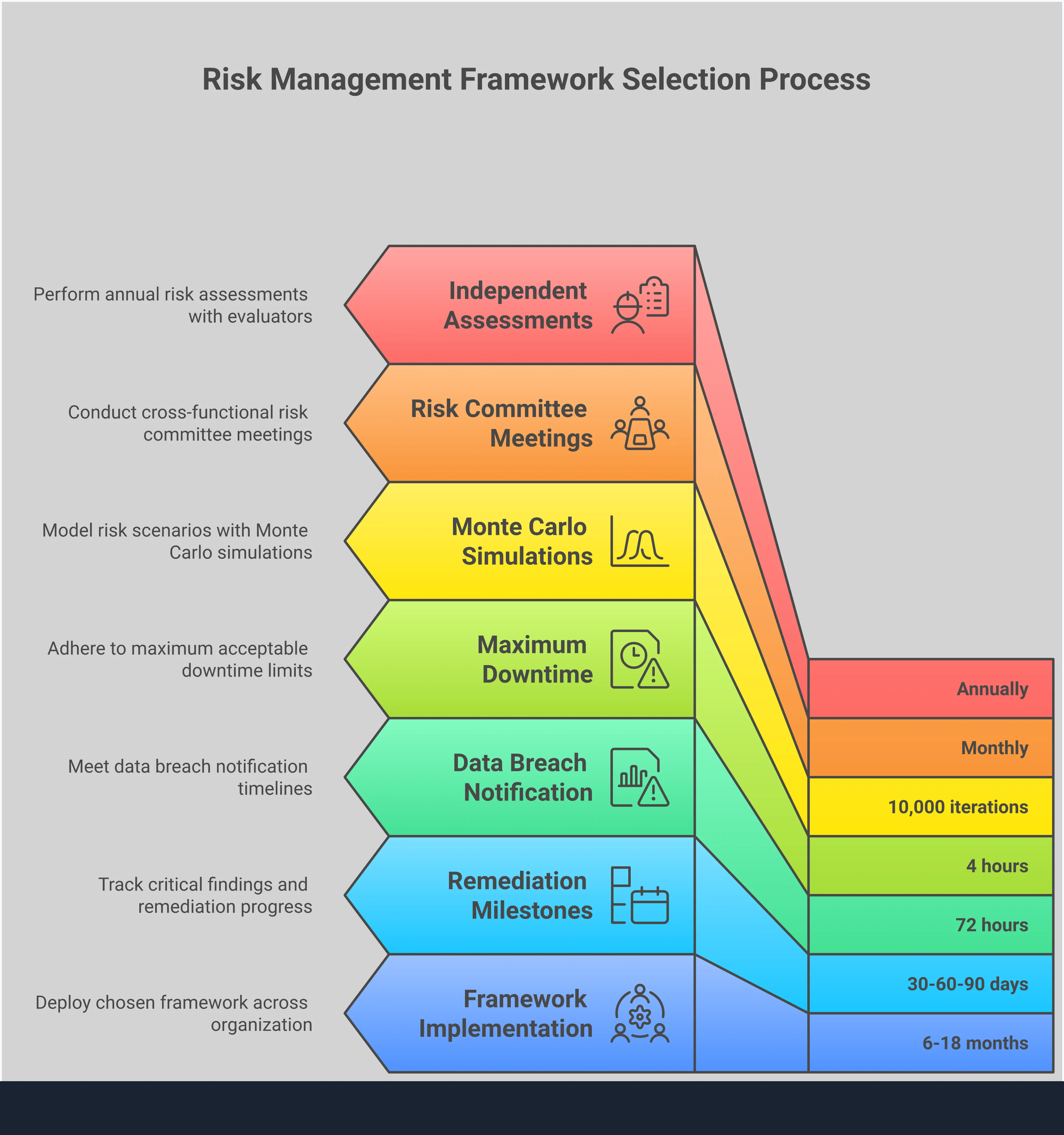
Selecting a risk management framework is not about finding a perfect, one-size-fits-all template. The most effective approach is one that aligns with your company’s specific goals, industry, and operational complexity. Each framework offers a different lens through which to view and manage risk. Your task is to find the lens that brings your organization’s risk landscape into the clearest focus. A mismatched framework can lead to wasted resources, compliance gaps, and a false sense of security. In contrast, the right framework provides a common language for risk across the organization, enabling clearer communication between departments and with leadership.
Before committing to a single model, evaluate your internal resources, team capabilities, and regulatory requirements. Some organizations may benefit from a hybrid approach, combining elements from multiple frameworks to create a custom system. For example, a tech company might use the NIST Risk Management Framework for its cybersecurity program while applying COSO principles to its financial reporting controls. The goal is to build a practical system that your team can implement and maintain, not just a theoretical model that looks good on paper. A well-chosen framework should feel like a natural extension of your business strategy, guiding decisions and strengthening operations from the inside out.
Finding the Best Fit for Your Team
The selection process should begin with a careful assessment of your organization's unique context. Consider the specific needs of your business, including the industry standards you must follow, the scope of your operations, and the primary risks you face. For instance, a company focused on broad, enterprise-wide risk might find the COSO framework to be a good fit. An organization looking for a more flexible and universal set of guidelines may prefer the principles outlined in ISO 31000.
The right framework should also match your team’s existing skills and the company’s culture. If your team is new to formal risk management, a more prescriptive framework might provide helpful structure. If you have a mature risk function, a principles-based framework could offer the flexibility needed to innovate.
Integrating Your Framework for Continuous Improvement
A risk management framework is not a one-time project. To be effective, it must be woven into your organization's strategy and daily decision-making processes. This integration ensures that managing risk becomes a core part of how your company operates, rather than a separate task performed by a single department. When risk management is part of everyone's job, the organization becomes more resilient.
Your framework must also adapt over time. Business objectives change, new threats emerge, and regulations evolve. Regularly reviewing and updating your framework is essential for keeping it relevant and effective. This process involves monitoring key risk indicators (KRIs) and performance metrics to assess how well your controls are working and to identify areas for improvement.
Related Articles
FAQs: Risk Management Frameworks
Table of Contents

Eric Sydell, PhD
Eric has two decades of experience in enterprise technology and was a founder of Modern Hire, which became part of Hirevue in 2023.