Article
Where to Buy AI Audit Software: A Buyer's Guide

Eric Sydell, PhD
|
Updated on
|
Created on
Maintaining a state of continuous audit readiness is a requirement for modern enterprises. Periodic, sample-based audits provide a limited view of your risk posture and can leave your organization exposed between cycles. AI audit software offers a more strategic approach by automating evidence collection and enabling continuous monitoring of controls. For Chief Compliance and Risk Officers, the conversation has moved beyond why this technology is needed to how it can be implemented effectively. This guide addresses the practical next step, answering the question, "Where can I buy AI audit software?" and outlining how to select a platform that aligns with your strategic governance, risk, and compliance objectives.
Key Takeaways
Move from periodic audits to continuous monitoring: AI audit software automates evidence collection and analysis, allowing your team to maintain a constant state of audit readiness. This shifts your compliance program from a point-in-time snapshot to a proactive, ongoing process.
Prioritize transparency and security over features: The most important capabilities are those that build trust. Select a platform with clear audit trails and explainable AI so you can defend its findings, and confirm it meets your security standards for protecting sensitive audit data.
Prepare your organization before you purchase: A successful implementation depends on your internal readiness. Address data quality, plan for staff training, and confirm the software is compatible with your existing systems to ensure the tool delivers its intended value.
What Is AI Audit Software?
AI audit software is a category of tools designed to automate and support audit and compliance activities. Traditional audits are often manual, time-consuming, and can only provide a snapshot of compliance at a single point in time. This makes it difficult for teams to keep pace with changing regulations and internal controls. AI audit platforms address these challenges by using artificial intelligence to check, monitor, and report on how systems and processes perform against established rules and ethical standards.
These tools are built to handle tasks that traditionally require significant human judgment, such as reviewing documents, collecting evidence, and identifying risks. At its core, this software helps organizations manage their governance, risk, and compliance (GRC) programs more effectively. Instead of relying on periodic, sample-based audits, companies can use AI to analyze large volumes of data on a continuous basis. This allows teams to find potential issues, validate controls, and demonstrate compliance with various regulatory frameworks in a more consistent and efficient way. According to research from oxethica, these tools are designed to verify that systems are performing as expected and adhering to necessary guidelines. By automating the human judgment layer of audit work, these platforms provide a structured way to interpret evidence and apply consistent logic across the entire organization.
Core Capabilities of AI Audit Platforms
AI audit platforms replace certain traditional audit procedures with automated analysis. This shift helps teams identify risks and analyze information more effectively. A report from KPMG International notes that this technology strengthens audit quality by enabling a better way to analyze client information.
One of the main functions is automated risk assessment. These platforms can process and understand information from many different sources at once. According to Wolters Kluwer, AI can "rapidly extract, summarize, and synthesize information from diverse sources, including policies, procedures, contracts, compliance reports, and meeting minutes." This allows auditors to quickly identify potential compliance gaps and control weaknesses without manually sifting through documents.
How They Benefit Compliance Teams
Compliance teams use AI audit software to manage the growing complexity of regulatory requirements. These tools automate routine tasks, allowing professionals to focus on more strategic work. As explained by AuditBoard, "AI helps teams stay ahead by automating regulatory tracking, identifying gaps in requirements, spotting compliance risks in unstructured data, and streamlining workflows."
This automation provides the speed and scale needed to keep up with a changing regulatory landscape. By continuously monitoring controls and analyzing evidence, the software helps organizations maintain a state of audit readiness. This reduces the last-minute rush often associated with preparing for an audit. The use of AI gives compliance teams the clarity and capacity to manage a volatile environment, ensuring that governance, risk, and compliance programs remain effective over time.
A Look at Today's AI Audit Software Platforms
The market for AI audit software includes several platforms, each with a distinct focus. Some platforms are designed for internal audit and compliance teams within large enterprises. These tools often integrate with existing governance, risk, and compliance (GRC) systems to automate evidence collection and control testing across the organization. They help internal teams manage a wide range of regulatory frameworks and internal standards, from information security to quality management. The primary goal is to create efficiency and provide a continuous view of the company's compliance posture.
Other platforms are built specifically for advisory firms that conduct audits for their clients. These tools are centered on engagement management, helping auditors streamline workflows from client onboarding to final report generation. They often include features for secure client collaboration, automated workpapers, and evidence management. For these firms, the software is a core part of their service delivery, enabling them to handle more clients with greater accuracy.
A third category specializes in auditing the AI systems themselves. As organizations deploy more machine learning models, a new set of risks emerges around fairness, bias, and transparency. These specialized platforms help companies test their AI models against ethical guidelines and regulatory requirements. They provide a technical framework for validating model behavior and ensuring that automated decisions are explainable and fair. Understanding these differences is the first step in finding the right tool for your organization.
Vero AI Governance Intelligence Platform
The Vero AI platform is designed for governance, risk, and compliance (GRC) analytics. It automates the human judgment involved in evaluating compliance evidence. The system works by interpreting and validating documents against management systems and enterprise controls. This capability allows compliance teams to move away from manual sampling and toward a more comprehensive review of their operational evidence.
This platform helps organizations prepare for audits and demonstrate compliance across multiple frameworks. Supported standards include ISO 27001 for information security, SOC 2 for service organizations, and HIPAA for healthcare data. The platform is built to provide continuous audit readiness, rather than focusing only on periodic audit cycles. The goal is to reduce manual evidence review and apply consistent interpretation of internal standards across all business units.
AuditBoard AI Automation Features
AuditBoard offers AI features to help audit, risk, and compliance professionals work more efficiently. The platform uses AI to provide insights and recommendations that augment a team's existing capabilities. It is not a standalone AI product but rather a set of features integrated into the broader AuditBoard platform for managing audit, risk, and compliance activities.
According to the company, "AuditBoard AI helps you work faster and smarter with AI-powered insights and intelligent recommendations." The software is designed to automate repetitive tasks. This includes activities like collecting evidence from different systems and testing the effectiveness of internal controls. The platform aims to free up auditors to focus on more strategic work, such as risk assessment and advisory.
Fieldguide AI-Powered Workflows
Fieldguide is an AI platform built for audit and advisory firms. Its purpose is to streamline engagement workflows, manage client requests, and automate testing and evidence review. The platform is designed to help these professional services firms improve their operational efficiency and enhance collaboration with their clients. It centralizes communication and document exchange, replacing scattered emails and spreadsheets.
The company describes its platform as using "special AI tools called 'Field Agents.'" These agents function as digital assistants for audit staff. They help with tasks such as checking client information, performing tests, and drafting reports. The Fieldguide platform is intended to help firms that provide audit and advisory services to their own clients, enabling them to scale their practices.
Oxethica Compliance Solutions
Oxethica provides software specifically for auditing AI systems. This tool helps organizations verify that their AI models comply with ethical, legal, and operational rules. The platform focuses on making AI systems more transparent and trustworthy, which is a growing concern for regulators and customers. It addresses the unique challenges of governing automated decision-making systems.
The company’s AI Audit Software is designed to address the specific risks associated with using AI, such as algorithmic bias or lack of explainability. It helps companies check their systems against established standards and frameworks for responsible AI. This type of software is for organizations that develop or deploy their own AI and need to govern its behavior and decision-making processes effectively.
How to Purchase AI Audit Software
Organizations can acquire AI audit software through several channels. The best path depends on your company’s procurement process, technical needs, and desired level of support. Common options include buying directly from the software vendor, using an enterprise marketplace, or working with a reseller. Each approach offers distinct advantages for your compliance and audit teams.
Understanding these purchasing models helps you find a solution that fits your operational requirements and budget. It also clarifies the type of relationship you will have with the provider, from direct technical support to broader implementation guidance.
Direct From Vendors
Purchasing directly from a software vendor is often the most straightforward approach. This path gives you direct access to the creators of the platform, which can be valuable for getting detailed product information and technical support. Direct engagement allows you to discuss your specific needs for Governance, Risk, and Compliance (GRC) and see how the software can be configured to meet them.
For example, vendors like AuditBoard offer platforms with AI models trained on GRC data to address specific audit challenges. Others, such as Fieldguide, provide AI-native platforms for audit and advisory firms. For organizations focused on AI ethics, a company like oxethica provides tools to audit AI systems against ethical and operational standards. Buying direct ensures you are speaking with specialists who understand the product inside and out.
Enterprise Software Marketplaces
Enterprise software marketplaces, like those from AWS or Microsoft Azure, offer a centralized place to find, buy, and deploy software. This can simplify the procurement process, especially for companies that already use these cloud platforms. Billing is often consolidated, which can streamline accounting and budget management.
However, pricing information can vary. Some vendors do not list public pricing and instead require you to contact their sales team for a custom quote. This is a common practice for complex enterprise software but can make initial budget planning difficult. In contrast, other platforms may offer transparent pricing tiers and free trials, allowing you to test the software before making a financial commitment. Reviewing a vendor’s marketplace listing can provide insight into their sales and pricing model.
Reseller and Channel Programs
Resellers and channel partners are third-party organizations authorized to sell and support a vendor’s software. They often provide value-added services, such as implementation, training, and consulting. Working with a partner can be beneficial if you need localized support or expertise in a specific industry or regulatory framework.
These partners can help you evaluate which platform is the right fit for your organization’s size and complexity. For example, some AI audit platforms are built for large enterprises with significant budgets, while others are better suited for smaller teams that need a lower-cost solution and a quicker setup. A reseller can provide objective advice based on your team’s specific goals, helping you find a tool that your team will be satisfied and engaged with.
Key Features to Prioritize in AI Audit Software
When evaluating AI audit software, certain features provide more value than others. Focusing on platforms that automate manual work, adapt to complex regulatory environments, and provide real-time insights can help your organization build a more resilient compliance program. Prioritizing the right capabilities ensures the software meets your specific audit and risk management needs.
Automated Evidence Collection
This feature is fundamental to reducing the manual burden on audit teams. Instead of manually sampling documents, the software automatically gathers and analyzes compliance evidence from various sources. According to research from Wolters Kluwer, AI can rapidly extract, summarize, and synthesize information from policies, contracts, and reports.
This allows auditors to move from tedious data collection to higher-value strategic analysis. Automated evidence collection provides a more comprehensive view of compliance, ensuring that assessments are based on a complete data set rather than a small sample. This leads to more accurate findings and a stronger audit posture.
Multi-Framework Support
Most organizations operate under several regulatory and industry standards, such as ISO 27001, SOC 2, or HIPAA. A platform with multi-framework support is essential for managing these overlapping requirements efficiently. It allows you to map controls across different frameworks, eliminating redundant testing and reporting.
This creates a harmonized compliance program where evidence for one audit can be reused for another. As noted by KPMG, companies are moving toward more harmonized and centralized processes to manage complexity. This capability simplifies audit preparation and demonstrates a mature, integrated approach to compliance for regulators and stakeholders.
Continuous Monitoring
Traditional audits provide a point-in-time snapshot of compliance. AI audit software enables a shift to continuous monitoring, where compliance is assessed in near real-time. This feature automatically flags non-conformities and potential risks as they arise, allowing teams to address issues proactively instead of discovering them during an audit cycle.
While the concept isn't new, Wolters Kluwer notes that AI-powered tools simplify the ability to leverage the results of continuous monitoring. Maintaining a constant state of audit readiness reduces the stress and fire drills associated with periodic audits and provides leadership with ongoing assurance.
Integration With GRC Systems
AI audit software should not operate in a vacuum. To be effective, it must integrate with your existing governance, risk, and compliance (GRC) systems. This integration creates a unified ecosystem for all compliance activities, from risk assessment to control testing and reporting.
It ensures that data flows smoothly between platforms, providing a single source of truth for your organization's risk posture. According to AuditBoard, AI helps by automating regulatory tracking and streamlining workflows across the compliance function. This connectivity enhances the value of your current technology stack and supports a more cohesive governance, risk, and compliance strategy.
Understanding the Cost of AI Audit Software
The price of AI audit software is rarely listed on a vendor’s website. Most providers use a custom pricing model based on your organization’s specific needs. To understand the total investment, you must look beyond the annual license and consider the complete cost of ownership. This includes the core subscription, the specific modules you select, and the initial costs for implementation and training.
The final price depends on several factors. The size of your organization, the number of users who need access, and the complexity of your compliance requirements all influence the cost. For example, a global enterprise that must comply with dozens of regulatory frameworks will have a different price structure than a smaller business focused on a single standard like SOC 2. When you request a quote, vendors will typically ask about your current audit processes, the volume of evidence you manage, and the systems you need to integrate with. This helps them build a package that fits your operational scale and budget. Preparing this information ahead of time can help you get a more accurate estimate.
Subscription-Based Pricing
Most AI audit platforms operate on a Software-as-a-Service (SaaS) model, which involves a recurring subscription fee. This fee is typically billed annually and grants you access to the platform, ongoing support, and any updates released during the contract term. The subscription cost is not a flat rate; it scales with your usage and the capabilities you require.
Pricing often depends on the number of users, the specific compliance frameworks you need to manage, and the volume of data the system will analyze. For example, some vendors may charge based on the number of controls or audits you run through the platform. According to industry analysis, annual contracts for enterprise platforms can range from $40,000 to $150,000. This pricing structure highlights the importance of getting a custom quote tailored to your organization’s size and compliance scope.
Enterprise Licensing
Vendors often structure their platforms into separate modules, allowing you to license only the capabilities you need. This modular approach lets you build a solution that targets specific areas of your governance, risk, and compliance (GRC) program. For instance, a company might start with a module for Information Security Management Systems (ISMS) based on ISO 27001 and later add another for Sarbanes-Oxley Act (SOX) compliance.
Each module may come in different tiers, such as an "Essentials" version for core tasks and a "Professional" version with more advanced automation and analytics. While this model offers flexibility, it also means the total cost will grow as you add more modules or upgrade tiers. It is important to map out your long-term compliance roadmap to anticipate which modules you might need in the future.
Implementation and Training Costs
The initial investment in AI audit software goes beyond the first year’s subscription fee. You must also budget for one-time costs associated with implementation and training. These services ensure the platform is configured correctly and that your team can use it effectively from day one. As one report notes, "The first year often costs more because of setup and training fees."
Implementation can include integrating the software with your existing systems, migrating data from legacy platforms, and configuring workflows to match your internal audit processes. Training ensures your compliance managers, auditors, and risk officers understand how to operate the new system, interpret its findings, and manage evidence collection. These upfront costs are critical for a smooth transition and for maximizing the return on your software investment.
How to Compare AI Audit Software
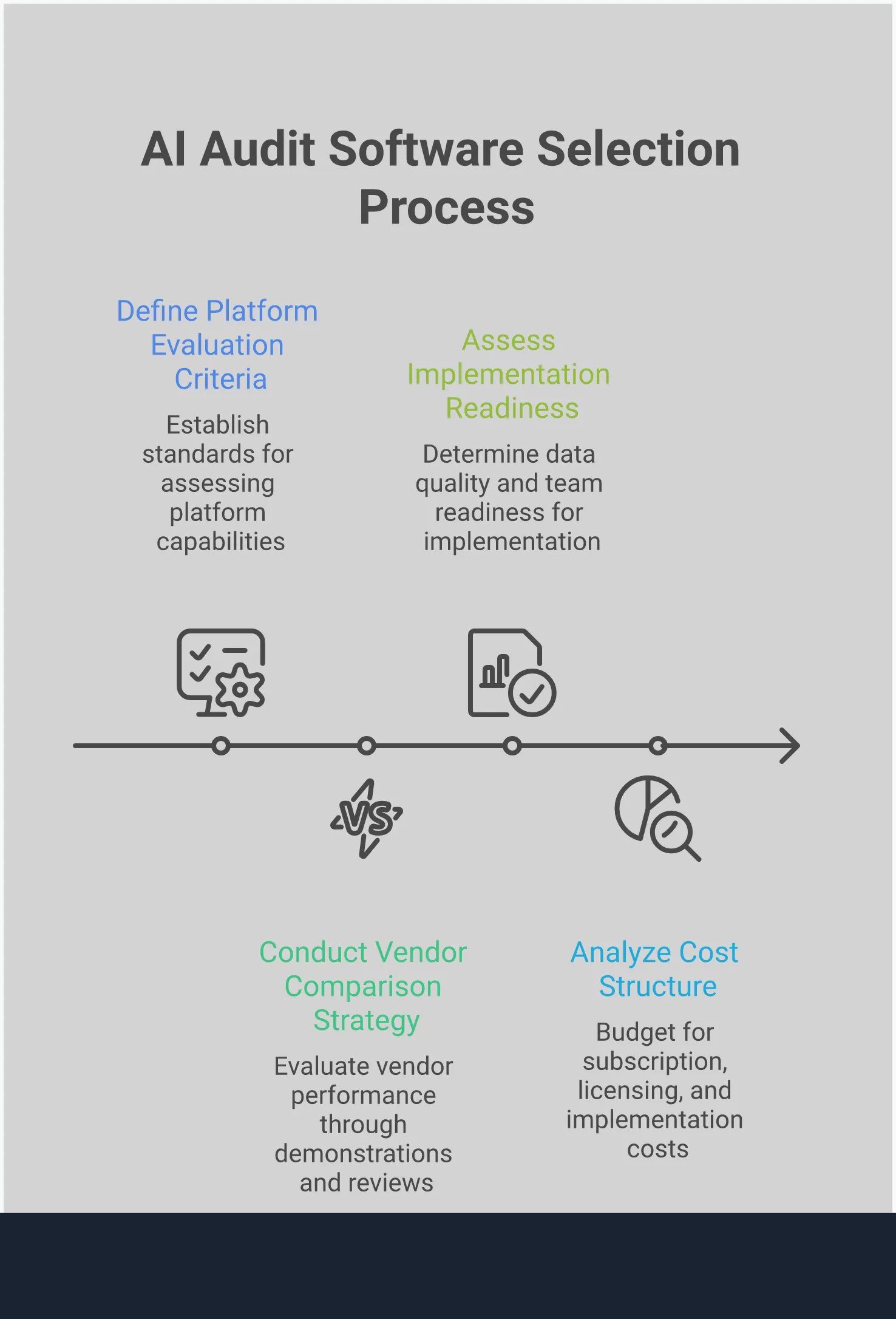
Choosing the right AI audit software involves more than just comparing features on a pricing page. A thorough evaluation requires a deeper look at how a platform will function within your specific operational environment. You need to understand how it handles your data, explains its conclusions, supports your team, and ultimately, builds trust with stakeholders. A superficial review can lead to selecting a tool that creates more problems than it solves, such as generating black-box outputs that auditors can't defend or having security protocols that don't meet your standards. This is especially true in highly regulated industries where the burden of proof rests squarely on your organization, not the software vendor.
To conduct a meaningful comparison, focus on four key areas that determine the long-term value and reliability of the software. These pillars are data security and privacy, model validation and transparency, the overall user experience, and the quality of vendor support programs. Assessing a platform through these lenses helps ensure that your investment not only improves efficiency but also strengthens your governance, risk, and compliance posture. It shifts the focus from what the software can do to what it will do for your team every day, ensuring the tool is an asset rather than a liability during a critical audit.
Evaluate Data Security and Privacy
Your audit evidence is highly sensitive, containing details about your operations, controls, and potential vulnerabilities. You must ensure any AI platform can protect it rigorously. Ask vendors detailed questions about their security architecture, including their data encryption methods both in transit and at rest, their access control policies, and the physical and logical security of their data centers. It's also important to clarify data residency—where your data will be stored geographically—to ensure compliance with any regional regulations.
While some AI models require huge amounts of data for training, the focus for audit applications is different. It's more important to understand how the software manages and protects sensitive data at the application level. Confirm that the vendor’s security measures align with your organization's governance, risk, and compliance requirements before making a commitment.
Assess Model Validation and Transparency
For an AI system to be useful in an audit, its findings must be trustworthy and explainable. Auditors cannot rely on a "black box" that produces conclusions without showing its work. You need to understand how the software reaches its conclusions to defend them to management, regulators, and external audit partners. Look for vendors that provide clear, comprehensive documentation on their AI models, how they are trained, and how they are validated for accuracy and bias.
The system’s output should include clear explanations and reference the specific evidence it analyzed. According to KPMG, ensuring there is an audit trail is a key challenge when auditing with AI. This transparency is essential for validating findings and maintaining the integrity of the audit process.
Review the User Experience
Even the most powerful software is ineffective if your team finds it difficult to use. A clunky or confusing interface can lead to low adoption rates, user frustration, and costly errors. The user experience is a critical factor for success. An intuitive platform allows auditors to focus on high-value analysis and professional judgment rather than struggling with the tool itself. The goal is to augment your team's skills, not to add another layer of technical complexity to their work.
AI-powered risk assessment can significantly enhance the auditor's ability to evaluate controls, but only if the platform is designed for their workflow. Always request a live demo or a trial period and, most importantly, involve the end-users in this evaluation. Their feedback is invaluable for determining if a tool will truly fit your day-to-day processes.
Consider Vendor Support Programs
A strong partnership with your software vendor is crucial for long-term success. The relationship should extend beyond the initial sale. Evaluate the level of support offered, from structured onboarding and initial training to ongoing technical assistance and strategic guidance. A good vendor acts as a partner, providing resources to help your team get the most out of the platform and adapt it as your compliance needs evolve.
As companies modernize their processes, they are benefitting from technology and the capabilities of their providers. Ask about the vendor’s customer support policies, service-level agreements (SLAs) for response times, and the availability of a dedicated account manager. Look for case studies or speak with current customers to understand the quality of their support and partnership in practice.
Find the Right Platform for Your Organization
The AI audit software market offers a wide range of solutions. The right platform for your company depends on its size, operational complexity, and industry-specific compliance needs. Vendors often design their products for distinct segments, from small advisory firms to global corporations.
Understanding these categories can help you narrow your search. A small business preparing for its first SOC 2 audit has different requirements than a multinational enterprise managing dozens of regulatory frameworks. By identifying which group your organization falls into, you can focus on vendors that understand your specific challenges. This targeted approach saves time and leads to a better long-term fit.
Solutions for Small to Medium Businesses
Smaller organizations and advisory firms often prioritize efficiency and ease of use. They need tools that can automate manual tasks and streamline audit workflows without requiring a large implementation team. Platforms in this category are typically designed to simplify evidence collection, testing, and reporting.
For example, some AI-powered platforms are built specifically for companies that perform audits and provide advice. Their primary goal is to make audit work easier and improve how firms collaborate with their clients. These solutions help smaller teams manage projects effectively, reduce administrative overhead, and deliver high-quality results with fewer resources.
Enterprise-Grade Platforms
Large enterprises operate in complex regulatory environments. They need scalable platforms that can integrate with existing governance, risk, and compliance (GRC) systems and manage multiple frameworks across different business units. These solutions are built to handle high volumes of data and provide robust controls for security and access.
Enterprise platforms often use AI models trained on vast amounts of governance, risk, and compliance information. For instance, AuditBoard AI is designed to help large companies manage these tasks more effectively. These systems give users control over how the AI operates and maintain detailed logs of all actions, ensuring the entire process is transparent and traceable for internal and external auditors.
Industry-Specific Platforms
Some industries face unique compliance and ethical challenges that require specialized tools. Companies in finance, healthcare, and technology often need AI audit software tailored to their specific regulations and operational risks. These platforms are designed with deep domain knowledge built into their workflows and analytical models.
For example, organizations that develop or use complex AI systems need to ensure they comply with ethical and legal standards. An AI audit tool from oxethica helps companies evaluate their AI for fairness, transparency, and accountability. As more industries benefit from AI, the demand for these specialized compliance solutions will continue to grow.
Prepare for Implementation Challenges
Adopting new AI audit software involves more than selecting a vendor. A successful rollout requires careful preparation within your own organization. Without a solid plan, you risk an implementation that fails to deliver the expected results for your governance, risk, and compliance (GRC) programs. The most common challenges arise in three key areas: the quality of your data, the readiness of your team, and the compatibility of your existing technology.
Before you commit to a platform, it is important to assess your internal landscape. This review of your own readiness is just as important as the evaluation of software vendors. Do you have clean, accessible data for the AI to analyze? Does your team have the skills to work with automated systems? Will the new software integrate with the tools you already use? Answering these questions upfront can save significant time and resources. Proactive planning helps ensure a smooth transition from manual processes to an automated compliance environment. This preparation allows your organization to fully benefit from the new system. The following steps outline how to address these potential obstacles before they become problems.
Address Data Quality and Integration
AI audit software relies on data to function. The system’s ability to identify risks and validate controls depends on the quality of the information it receives. If your data is incomplete, inconsistent, or stored in disconnected systems, the AI’s output will be unreliable.
To prepare, focus on improving your data governance practices. This involves creating clear processes for how data is collected, stored, and managed. According to research from Certa, integrating data from different departments gives AI systems a more complete view of operations, which helps them monitor compliance effectively. Start by identifying the key data sources needed for your compliance frameworks and work to standardize them.
Plan for Staff Training
AI tools are designed to support your audit and compliance teams, not replace them. However, your staff will need new skills to use these platforms effectively. They must learn how to operate the software, interpret its outputs, and validate its findings.
According to experts at Wolters Kluwer, internal audit teams need to develop new capabilities to properly leverage AI-powered risk assessment. Training should cover both the technical aspects of the software and the strategic side of working with AI. This includes understanding how the models work and knowing when to question an automated recommendation. A well-trained team can combine its expertise with the AI’s analytical power to make better decisions.
Check Legacy System Compatibility
Many organizations rely on established systems that may not easily connect with modern AI platforms. This lack of compatibility can create technical hurdles during implementation. It can prevent the smooth flow of data required for automated analysis.
Before selecting a vendor, map out your existing technology. Identify the key systems that the AI audit software will need to connect with, such as your document management or governance, risk, and compliance tools. As one analysis on AI in auditing notes, integrating with legacy systems is a common challenge. Discuss integration capabilities with potential vendors early. Ask about their experience connecting to similar systems and whether they use application programming interfaces (APIs) to exchange data.
How to Evaluate AI Audit Software Before You Buy
Choosing the right artificial intelligence (AI) audit software requires a careful evaluation process. Your goal is to find a platform that not only automates tasks but also aligns with your organization’s specific compliance and governance needs. A thorough assessment goes beyond a simple feature comparison. It involves understanding how the software integrates with your existing workflows, supports your regulatory frameworks, and provides the transparency required for internal and external audits.
To make an informed decision, focus on three key areas. First, see the platform in action through live demonstrations and trials. This helps you understand its real-world capabilities. Second, confirm that the software supports the specific regulations and standards your organization must follow. Finally, examine the quality of its documentation and audit trails. These records are essential for explaining the AI’s findings to regulators, auditors, and leadership. A structured approach to these steps will help you select a platform that strengthens your compliance program.
Request Demos and Trials
A live demonstration is one of the most effective ways to evaluate an AI audit platform. It allows you to see how the software handles specific tasks and fits into your team’s daily operations. During a demo, you can observe how the system automates routine work, such as evidence collection and analysis. This can show you how AI agents are designed to handle repetitive tasks, freeing up your experts to focus on strategic decisions and judgment.
Come prepared with a list of your most common use cases and challenges. Ask the vendor to show you exactly how their platform would address them. This helps you move beyond a generic sales pitch and see if the software can truly improve your governance, risk, and compliance (GRC) processes.
Assess Compliance and Regulatory Support
Your chosen AI audit software must support the specific standards and frameworks your organization adheres to. Whether you need to comply with ISO 27001, SOC 2, or HIPAA, the platform should have the built-in capability to manage those requirements. AI can help teams stay ahead by automating regulatory tracking and identifying gaps in compliance. This is critical, as effective AI compliance requires close collaboration across security, legal, and governance teams.
Ask vendors for a detailed list of the frameworks their platform supports. Inquire about their process for updating the system when regulations change. The right software should act as a reliable partner in maintaining continuous compliance, not just a tool for one-time audits.
Review Documentation and Audit Trails
Transparency is critical when using AI in an audit context. You must be able to explain how the software arrived at its conclusions. Ensure any platform you consider provides clear, comprehensive documentation and maintains a detailed audit trail for all its actions. According to guidance from KPMG, this is one of the key challenges of auditing AI systems.
The software should automatically generate records of how evidence was collected, analyzed, and validated. These logs are essential for demonstrating compliance to external auditors and regulators. During your evaluation, ask to see examples of these reports. They should be easy to access, understand, and export for review.
Related Articles
AI Audit Automation Software FAQs
Table of Contents

Eric Sydell, PhD
Eric has two decades of experience in enterprise technology and was a founder of Modern Hire, which became part of Hirevue in 2023.